6 Bodice Ripper Authors Who Built Old School Romance
From Woodiwiss 1972 to Deveraux 1980 — the six paperback authors who built a publishing industry on female sexual interiority. Some you remember. Most you forgo

The bodice ripper is remembered as Kathleen Woodiwiss's invention. It was actually a six-author publishing experiment that became an industry within eight years.
Avon published The Flame and the Flower in 1972 as a publishing bet: that women paperback readers would buy explicit sexual content rendered through female erotic interiority, if delivered at mass-market price and shelf-positioning. The bet returned 2.35 million copies sold within the first year. Avon followed Woodiwiss with Rosemary Rogers in 1974. By 1980, the publisher had a dedicated bodice ripper imprint, four of the year's bestselling paperbacks were romance, and Johanna Lindsey, Bertrice Small, Catherine Coulter, and Jude Deveraux had each published their debuts in the eight-year window.
These six women — collaborating only inadvertently, sharing only a small handful of publishers willing to buy explicit female-POV historical fiction — built the structural template that fifty years later makes BookTok-era dark romance commercially viable. Some of their names BookTok remembers. Most it forgot.
This is the list.

The Flame and the FlowerKathleen Woodiwiss (1972)
The Avon experiment. The Flame and the Flower was the first full-length romance novel published as a paperback original rather than hardback first, the first to render female erotic interiority explicitly in mass-market commercial fiction, and the founding text of what trade journalism would soon call the «bodice ripper» based on its cover-art template.
Heather Simmons, the heroine, occupies the POV. Captain Brandon Birmingham, the dangerous man, is rendered through Heather's reading of him. This was the structural inversion of male-coded crime fiction's POV economy.
The book sold 2.35 million copies within its first year. Woodiwiss followed with The Wolf and the Dove in 1974, and continued publishing until her death in 2007.
She built the template. Everyone in this list executes a variation of it.
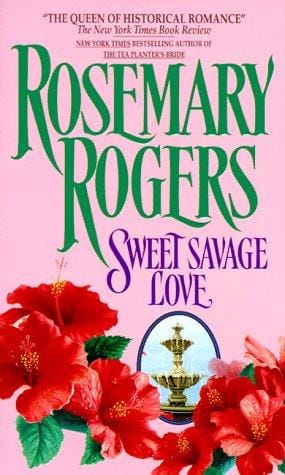
Sweet Savage LoveRosemary Rogers (1974)
Where Woodiwiss was technically explicit but emotionally restrained, Rogers was explicit and emotionally chaotic. Sweet Savage Love (1974) and Dark Fires (1975) pushed the bodice ripper template toward greater violence, longer sagas, and multi-generational scope.
Dark Fires sold two million copies in three months. The «epic bodice ripper» — international settings, multi-generational dynasty plots, sexual content explicit to the edge of what mass-market paperback could carry — was Rogers's invention.
She demonstrated the template was scalable to longer commercial runs and bigger ambitions. Her books were the proof that bodice ripper wasn't a category but a commercial mode.

Captive BrideJohanna Lindsey (1977)
Lindsey published her debut Captive Bride in 1977 and didn't stop until her death in 2019. She published more than 50 novels and sold tens of millions of books across her career.
Where Woodiwiss anchored European historical, Lindsey took bodice ripper to American Western frontier, Viking settings, Regency England, and contemporary romance. She demonstrated that bodice ripper authors could remain commercial across changing fashions, that the template could survive the era of its origin.
Lindsey was the one who made bodice ripper sustainable. Without her decades-long output, the genre's claim to being mainstream commercial fiction would have collapsed in the 1990s.

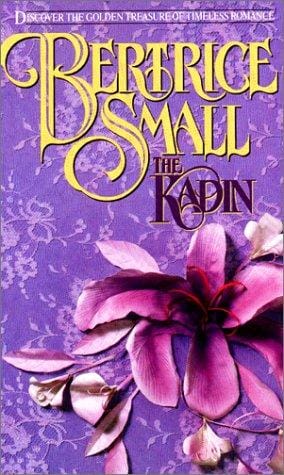
The KadinBertrice Small (1978)
Small's debut, The Kadin (1978), took the bodice ripper template to Ottoman empire and harem settings: Lady Janet Leslie of Scotland abducted to Crete and sold into the household that produces the mother of Suleiman the Magnificent. Small spent five years researching the Ottoman court before writing the novel, by her own account.
The historical accuracy was a selling point, not background detail. Small pioneered the «scholarly bodice ripper» — explicit sexual content nested inside meticulously-researched historical settings. Her books required readers to bring some interest in Renaissance Mediterranean geopolitics to the experience.
She demonstrated that bodice ripper could be intellectually serious without abandoning its commercial register. The genre wasn't only sex; it could also be the way American women learned premodern history.
The bodice ripper wasn't one author. It was an Avon-led publishing experiment that scaled to six authors and a dedicated retail aisle within eight years.
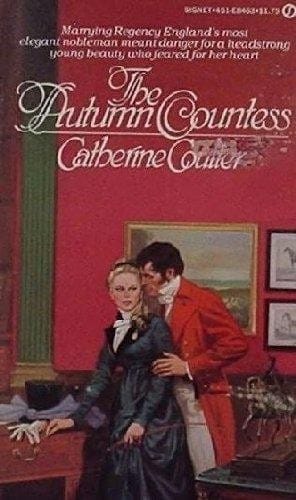
The Autumn CountessCatherine Coulter (1978)
Coulter's debut The Autumn Countess (1978), published by Signet, was, in her own characterization, "a Gothic masquerading as a Regency". She used first-person narration in classic Gothic style — heroine speaks directly — combined with bodice ripper sexual content and murder-mystery plot scaffolding.
Coulter demonstrated that the bodice ripper could absorb adjacent genres. Gothic suspense, regency comedy of manners, contemporary thriller, she eventually wrote all three. Her FBI thriller series, which began in 1996, sold tens of millions of copies on top of her bodice ripper foundation.
She proved bodice ripper authors weren't trapped in their original niche. The skill that built bodice ripper — combining explicit content, female-POV interiority, plot architecture — was transferable to entire other genres. This was the precedent for the modern romance author who pivots to thriller, women's fiction, or literary at will.
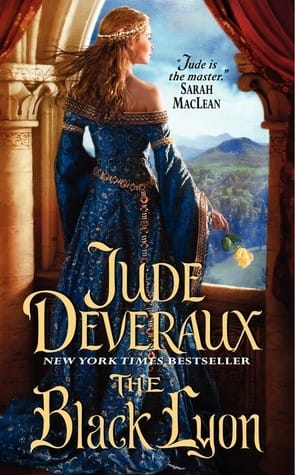
The Black LyonJude Deveraux (1980)
Deveraux's The Black Lyon (1980) closed the bodice ripper's founding decade by bringing lighter tone into the template. Where Rogers wrote violence and Small wrote scholarship, Deveraux wrote bodice ripper with humor and a sense of romantic comedy underneath the explicit content.
She also pioneered the «family saga» format — interconnected novels following multiple generations of a single family across centuries. The Velvet tetralogy (1981-1983), the Montgomery/Taggert family saga that The Black Lyon itself opened, and the James River trilogy were architectures of multi-volume engagement that later mafia romance authors would directly inherit.
Deveraux demonstrated that bodice ripper could be a chassis for commercial publishing's long-game strategy. Get a reader on book one of a saga, and you have committed her to ten years of releases.
What they built
The bodice ripper era closed somewhere between 1985 and 1990. Sweet contemporary romance replaced explicit historical. Paranormal romance arrived in the 1990s with vampires (Christine Feehan's Carpathians, 1999) and continued the dangerous-man-female-POV template into supernatural settings. Contemporary dark romance arrived in the 2010s on platforms (Wattpad, Kindle Direct Publishing) the founding six couldn't have anticipated.
Lindsey kept publishing Lindsey-templated bodice rippers until her death in 2019. Small kept writing Ottoman epics until hers in 2015. Coulter pivoted to thrillers. Deveraux pivoted to time-travel romance.
The structural innovations they made together — full-length female-POV historical with explicit content, mass-market paperback distribution, multi-volume saga as commercial unit, historical research as marketing — became the chassis on which contemporary BookTok dark romance was built. Cora Reilly's mafia chronicles descend directly from Bertrice Small's harems via the same Avon-engineered distribution template. Penelope Douglas's dark high-school novels descend from Catherine Coulter's gothic-as-regency disguise.
These six built the industry. The names BookTok currently celebrates inherited it.
The forgotten-classics tradition continues: every genre has its founding generation, and every founding generation is at risk of being remembered only for the one or two members who became famous.
These six all deserve more.