The #Bookstagram Aesthetic: How Instagram Restyled Reading
The platform that used to share books quietly started choosing them. A field report from inside the grid.
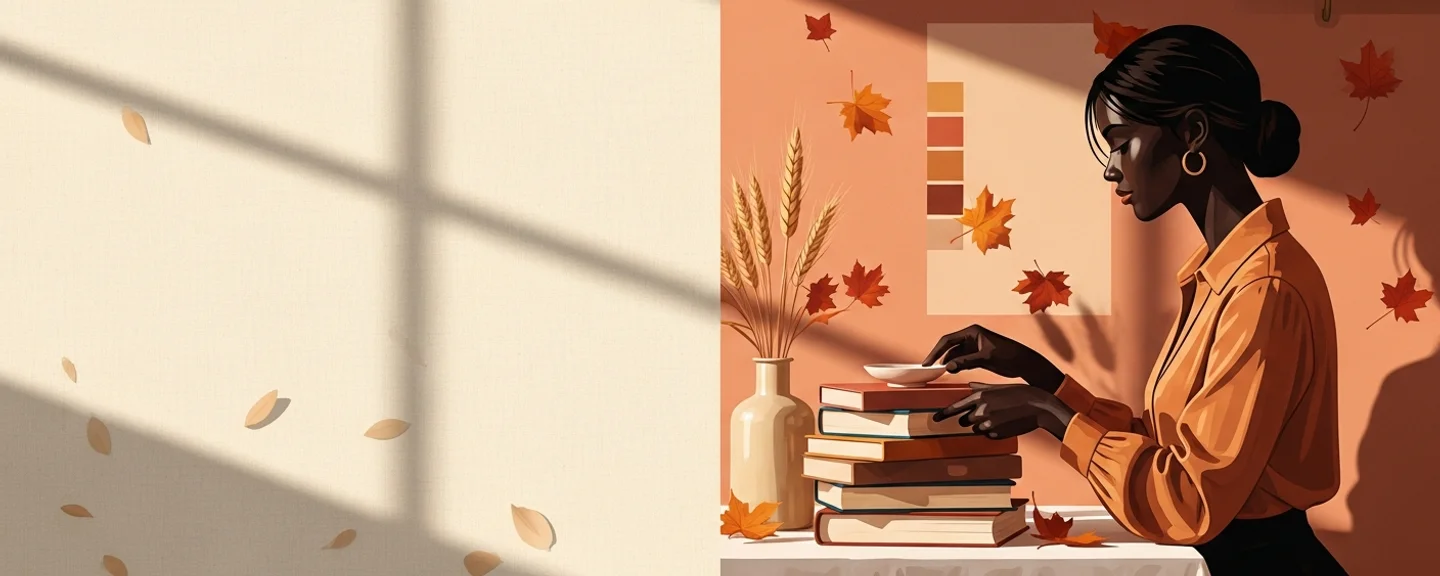
Open Instagram and search "bookstagram." The first thing you see is not a book.
It is a photograph of a book, photographed in a way that suggests the book itself is incidental: set among a coffee cup tilted just so, a hand holding it open to a page whose typography someone has clearly chosen, a linen throw draped to soften the corner of the frame. The book is the prop. The image is the product.
The hashtag, currently parked at forty-six million posts and another six hundred and twenty-seven million reels, is what we have come to mean when we say "reading community" online. We do not mean a community of readers. We mean a community of photographers who have agreed on what reading should look like.
That difference is not pedantic. In the last three years it has rearranged a quarter of the publishing industry's marketing budget. The shape of the two communities, mapped against each other, is a separate story; what follows is about what Bookstagram, specifically, does to the books that pass through it.
The flatlay imposes
When BookTok arrived in 2020 and 2021, what it offered the book world was a kind of leveling. The algorithm did not care about cover design. It did not care about jacket copy. It did not care about whether a book fit into a coordinated visual brand.
It cared about hooks: the sobbing creator with a paperback held up to the camera, the voiceover declaring you will never recover from chapter twenty-three, the screen-captioned quote in white serif on black.
Colleen Hoover received roughly the same algorithmic respect as Sally Rooney. Paranormal romance got the same view counts as literary fiction with a Booker shortlist. For perhaps three years, what got read was decoupled from what looked good on a shelf at Strand.
Bookstagram does not work that way. It never has.
A flatlay imposes a selection at the moment of staging, before anyone has read a word. The book has to photograph. The cover has to match the palette of the feed. The spine has to harmonize with the autumn-leaf overlay or the cream-linen background.
Books whose covers are designed around a single saturated color (the matte navy of Tomorrow, and Tomorrow, and Tomorrow, the lemony yellow of Beach Read, the carmine of Yellowface) float to the top because they slot into the grid. Books with busy jackets, with stock-photo author headshots, with serif titles on muddy backgrounds, sink.
This is not a judgment about literary merit. It is the platform's logic stating, plainly, what it requires.
The interesting thing about that logic is that publishers have learned to read it.
The image is the argument
In the months before Tomorrow, and Tomorrow, and Tomorrow went viral, a small format experiment was making its rounds on Bookstagram: the color-coded three-word review. The idea was simple.
You wrote three words about a book. You set each word in a color block matched to the cover. The text was almost incidental, three syllables on a square. The image was the work.
Within months the format had migrated, screenshot by screenshot, to BookTok and Twitter and Goodreads. The book that became its avatar was Gabrielle Zevin's literary novel about video-game designers, out for the better part of a year, settled comfortably into the kind of respectable midlist career that critics like and bookstores tolerate.
After the color-block trend caught, Barnes & Noble sold out of the paperback in a single weekend. Knopf expedited a reprint.
---
What happened there is worth pausing on. The book itself did not change. The reviews did not change. What changed was that someone built an image template that the book happened to slot into perfectly.
The muted teal cover. The title that breaks into three repeating words. The readability of the spine on a stacked shelf.
Tomorrow, and Tomorrow, and Tomorrow was, retroactively, designed for the format that ended up selling it. The image came first. The reading came after, if it came at all.
This is the part of Bookstagram that polite criticism tends to step around. The unit of literary judgment on the platform is the photograph. The text below it (three words, six words, sometimes a paragraph) is in a kind of evidentiary role, certifying that the person who took the photograph also read the book.
The photograph itself is the argument. And the photograph rewards a very specific set of qualities, color cohesion, spine legibility, mass-market dimensions, jacket finish, that have approximately nothing to do with what is inside.
The same failure-mode appears in AI-generated romance prose, where the sentence is correct and the longer arc collapses underneath it; on Bookstagram the equivalent failure is invisible, because the image is not supposed to support anything past itself.
The lookbook logic
For about three years it was possible to argue that social media had dismantled the old taste hierarchy in publishing. The New York Times Book Review and the bookstore staff-pick shelf and the literary-festival keynote no longer owned the gate.
A teenager with a ring light could revive a quietly released midlist novel into a bestseller overnight. The line "BookTok made me read it" appeared on display tables in chains and independents alike.
For the older critics this was either a vandalism of public taste or an overdue democratization, depending on whom you asked.
Bookstagram is, quietly, the project of restoring a hierarchy. Not the literary one (Sally Rooney still has Sally Rooney's audience) but a new one, built around aesthetic legibility.
Books that look right on Instagram circulate. Books that do not look right on Instagram remain books. The hierarchy is not declared anywhere. It is enforced by the grid.
The unit of literary judgment on Bookstagram is the photograph. The text below it is in an evidentiary role.
You can see this in the kinds of accounts that have grown fastest in the last two years. They are curators, not critics. They post in palettes. They schedule their feed by season: chestnut and cream in October, periwinkle and chartreuse in spring.
The recommendations they make are inseparable from the photographs that accompany them, and the photographs are inseparable from the rest of the feed. To follow a high-reach bookstagram account is to subscribe to a coordinated visual brand inside which certain books are surfaced because they sustain the brand.
This is a form of editorship. It is much closer to the editorship of a fashion magazine than to the editorship of a literary review.
The fashion-magazine comparison is the right one, and it is the one publishers have made internally for at least a decade. Vogue's October issue, the seasonal lookbook, the front-of-book trend report all run on the same logic.
Items are selected because they cohere, not because they are individually exceptional. Their meaning is supplied by adjacency. A coat lives next to a bag, lives next to a bracelet, lives next to a perfume. Pull any one of them out of the spread and it dims.
Bookstagram applies the lookbook logic to literature. The romantasy aesthetic is a particularly aggressive instance of this: hammered-metal cover treatments, foil titles, fae illustrations across a single tonal range, an entire subgenre's visual identity tuned to the grid before the books inside it had cohered into anything else.
Penguin reads the grid
Penguin Random House's 2025 quarterly reports describe a deliberate shift of influencer budget toward Bookstagram and YouTube, away from the TikTok ecosystem rocked by a year of legal uncertainty and a sustained twenty-to-thirty-percent decline in creator engagement.
They were not chasing reach. BookTok still has the larger audience. They were chasing controllability.
The shift is significant for the same reason the lookbook comparison was. On Instagram a publisher can match the aesthetic.
The cover designer can be briefed against a palette. The mailers can be styled to photograph. The seeding program can be timed to a creator's existing visual calendar.
None of this is possible on TikTok, where the only variable a publisher can move is whether a creator likes the book enough to perform an unscripted reaction. TikTok's volatility is its democracy. Instagram's controllability is its hierarchy.
TikTok's volatility is its democracy. Instagram's controllability is its hierarchy.
This is not a secret. The Berkley imprint runs a public influencer program. Penguin's own creator-partnership pages describe a coordinated visual approach.
Walk through any acquisitions meeting in 2026 and ask what the book will look like on a flatlay. (The algorithm requires this. The team requires this. The cover designer was hired with this in mind.) The book itself is the last variable.
What that means, working backward from the publisher to the page, is that the books being acquired now are being acquired with the grid in view. Cover designers brief upward at every stage. Marketing teams see the lookbook reference before they see the manuscript.
The book that wins the acquisition is, increasingly, the book whose object-design already photographs.
The economics of authorship under this regime are visible most clearly in the pseudonym economy: a writer's career increasingly diverges from a writer's name, because the name is a brand and the brand is a visual unit.
What reading becomes
A book that has been pre-styled to be photographed is a book that has been already partly read before you open it. The cover knows what it has to do. The book design knows what palette to slot into. The marketing copy is written with one eye on what would caption well.
There is a deep loop here, and you do not have to be paranoid to see it: a book is acquired with an eye toward whether it will photograph, edited toward what photographs, designed for the grid, marketed through accounts that have built audiences on the grid, photographed by readers who learned what to photograph from the grid, and read, by everyone in this loop, with the awareness that the next image is coming.
This is not the death of reading. It is reading at a different temperature.
There is a peculiar pleasure, often genuine, in living inside a coordinated visual world in which the books you read have their place imagined before you bought them. The pleasure is partly aesthetic, partly social, partly the small daily ritual of curation.
To call it shallow is to miss what it actually is. It is reading as inhabitation of a designed space.
It is not a betrayal of reading. It is a different practice that has adopted the name.
---
The argument worth having is not whether this is good or bad. The argument worth having is whether the publishing industry will continue to underwrite books whose covers fail the grid test.
Forty-six million flatlays, six hundred and twenty-seven million reels, and one Penguin Random House quarterly report indicating where the money is going. This is what an industry choosing its inputs looks like.
What gets read in 2027 is being decided now, on Instagram, by people deciding whether the cover will work next to the candle.