How to Read Dark Romance: A Reading List from Wuthering Heights to the Present
The dark romance lineage from the Brontës through the bodice-rippers to BookTok: a reader's history of the trope that never actually disappeared.
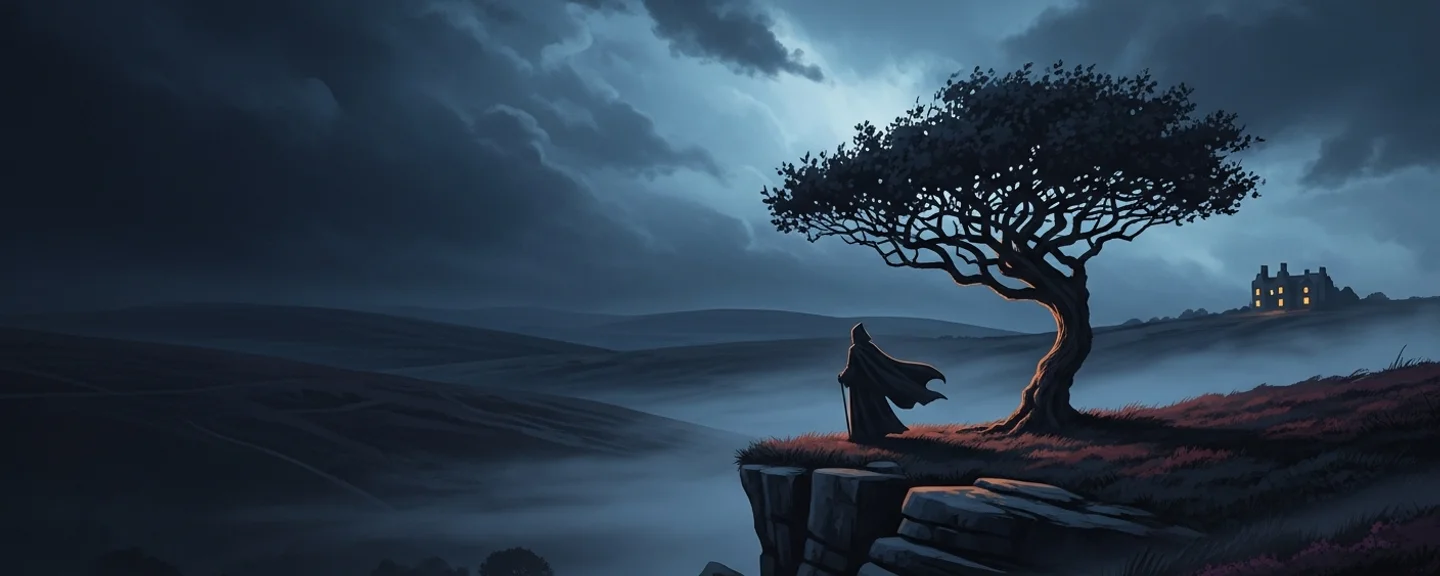
Dark romance did not begin with TikTok. It began on the moor.
When BookTok declared dark romance a 2022 invention, it was working with a definition the form itself had spent nearly two centuries refining. The morally compromised love interest, the captive heroine, the seduction-as-survival negotiation, the lover who is also the threat. Every component the modern dark romance treats as new was already on the shelf when Emily Brontë published Wuthering Heights in 1847.
What changed across the intervening 175 years is not the appetite. The appetite is constant. What changed is what readers were permitted to print. The Brontës wrote the trope as far as Victorian publishing would let them. The bodice-rippers of the 1970s printed the scenes the Brontës had to imply. Anne Rice gave it fangs. Penelope Douglas gave it BookTok. Each generation inherited the structure and pushed the explicit limit a half-step further.
This is a reading list across the lineage, decade by decade. Read in order, the books form a single conversation about what women have wanted to read about danger, and what each era allowed them to put on the page.
1847: The Brontës
The two foundational texts of dark romance were published within months of each other, by two sisters working in the same household.
Wuthering Heights is the unambiguous origin. Heathcliff is the prototype of every brooding morally compromised hero in the subsequent canon. He is cruel, vengeful, fixated on Catherine to the point of self-destruction, and the novel does not redeem him. The love is presented as terrible and inevitable. The reader is asked not to forgive Heathcliff but to recognise the gravitational pull he exerts on Catherine, and on the narrative. Modern dark romance still uses this exact structure: the love interest is not safe, the love is not safe, the question is whether the reader can stand inside the recognition.
Jane Eyre, published the same year by Charlotte Brontë, is the safer twin. Rochester is dangerous but redeemable. He has a wife in the attic, but the novel positions this as a problem to be resolved rather than a structural feature. Jane gets a moral resolution Catherine never receives. The contemporary romance genre is, in many ways, the Jane Eyre branch of the lineage. Dark romance is the Wuthering Heights branch.
If you want to understand where the genre starts, read both, in their original chronology. Notice how much closer Brontë''s prose is to a 2022 dark-romance book than to a 2022 contemporary one. The pacing is different and the diction is heavier, but the emotional logic is identical.
1938-1979: The Gothic intermission
The trope did not disappear after the Brontës. It moved into Gothic fiction, and stayed there for a hundred years.
Daphne du Maurier''s Rebecca (1938) is the most quoted entry. The unnamed second wife arrives at Manderley to find herself haunted by her predecessor and married to a husband whose moral position the novel will not resolve until the final chapters. The threat is ambient and the romance is unsafe. Rebecca is the Brontë formula moved to the twentieth century with a tighter prose register and a more controlled narrator. It sold continuously through the next eighty years and was adapted into film four times, most recently in 2020.
V.C. Andrews''s Flowers in the Attic (1979) marks the moment the genre crosses into transgressive territory and stays there. Incest, captivity, parental cruelty: the novel made its name by writing what mainstream women''s fiction would not, and it stayed in print for forty years on the strength of that. Andrews''s books were the first major commercial proof that women would buy dark fiction in volume, repeatedly, across the decade-long careers of the readers who started in their teens.
Read Rebecca for the prose. Read Flowers in the Attic for the proof of audience.
The bodice-ripper turn (1970s)
In 1972, Kathleen Woodiwiss published The Flame and the Flower with Avon. The book printed the explicit consummation scenes that all previous mass-market romance had implied off-page. It sold over two million copies and rewrote the rules of what a paperback romance was allowed to contain.
The Flame and the Flower is dark romance by every modern definition. The heroine is mistaken for a prostitute by the hero. He assaults her. The novel proceeds from there into what subsequent decades would call captor romance, and reframes the early violation as the foundation of a love story. Contemporary readers find the book difficult; that difficulty is the point. The 1972 book printed what the 1847 book could only gesture at.
Rosemary Rogers''s Sweet Savage Love (1974) was the more explicit successor. Bertrice Small, Johanna Lindsey, Catherine Coulter: the bodice-ripper decade was a continuous publishing event that sold tens of millions of copies through the 1970s and into the 1980s. Every contemporary dark-romance trope from kidnapping to captor-redemption to forced marriage was codified in this period.
The literary establishment dismissed these books at the time. The retroactive reading is more interesting. The bodice-rippers were the first commercial expansion of the trope into mass-market explicit content, and they answered the question of whether women would buy that content directly. They would.
The bodice-rippers did not invent dark romance. They printed the scenes the Brontës were too modest to put on the page.
1976-2000s: Vampire and the monster
Anne Rice''s Interview with the Vampire (1976) inaugurated the next phase. The novel was not marketed as romance — Rice resisted the label — but its narrative logic was unmistakable. The vampire is dangerous, alluring, morally compromised, and the human relationships in the book are structured around the question of attraction-to-the-monster. Subsequent vampire fiction, including the entire commercial paranormal romance subgenre that followed, took its structural cues from Rice.
The vampire trope did the dark-romance work in plausibly deniable form. The hero could be more dangerous than a 1970s human alpha because he was not, technically, human. The transgression could go further because the framing was supernatural. Laurell K. Hamilton''s Anita Blake series (from 1993) pushed the explicit content further into territory contemporary mainstream publishing was still uncomfortable with for human protagonists. Sherrilyn Kenyon, Christine Feehan and J.R. Ward built mass-market paranormal romance on this foundation through the 2000s.
If you want to read the lineage in one volume from this period, choose Interview with the Vampire. If you want to see where the explicit content was moving, read the first three Anita Blake novels. The pre-Twilight vampire canon is a parallel lineage that ran through these same decades, and the paranormal romance boom of the 2000s makes more sense once you have seen both tracks at once.
1990s-2000s: Alpha captivity
While the paranormal track ran in parallel, the human side of dark romance was consolidating around what publishers eventually called the romantic-suspense alpha. Linda Howard''s Mr. Perfect (2000) and Open Season (2001), Catherine Coulter''s FBI series, Sandra Brown''s standalones: the form was a romance set inside a thriller structure, with a dangerous love interest who is not always on the right side of the law.
This was the decade captivity romance reached commercial maturity. Books in which the heroine is abducted, held, threatened, and eventually paired with her captor sold in volume across the 1990s and into the 2000s. The conventions tightened. The captor must be physically dangerous but capable of being moved by the heroine, the captivity must be morally framed as protective in the long run, and the resolution must include genuine remorse without erasing the original event.
Most contemporary BookTok dark romance descends directly from this era. The captor-protector trope, the alpha-as-shield, the dangerous-but-devoted hero. These are 1990s commercial fiction tropes refined for a 2020s reader with a higher tolerance for explicit content and a lower tolerance for sentimental closure. The mafia anti-hero is the most direct contemporary inheritor of this 1990s structure.
2011-present: Indie digital and BookTok
In 2011, CJ Roberts self-published Captive in the Dark through Kindle Direct Publishing. The book is, in the modern reckoning, the first commercially significant indie dark romance. It is also the entry point that proves the lineage is unbroken. Captive in the Dark runs the same captive-and-captor structure as Woodiwiss in 1972, refined for explicit content the bodice-rippers did not have access to, distributed through a publishing channel the 1990s did not have access to. The trope is identical. The interface is new.
The decade that followed produced the contemporary dark romance canon: Anna Zaires''s Twist Me trilogy (2014), Aleatha Romig''s Consequences series, Pepper Winters, Sarah Castille, Vi Keeland. By 2018 the subgenre was the most consistently bestselling category in indie romance.
BookTok arrived on top of an existing genre. Penelope Douglas, H.D. Carlton, Ana Huang and Sarah J. Maas''s ACOTAR series did not invent dark romance. They amplified a subgenre that had been quietly selling at scale for a decade. The BookTok community made the lineage visible to readers who had not been tracking it, which is a different thing from inventing it.
If you want a current entry point that demonstrates the full inheritance, Anna Zaires''s Twist Me runs the trope cleaner than most contemporary releases and acknowledges its bodice-ripper ancestry openly. Penelope Douglas''s Credence and H.D. Carlton''s Haunting Adeline are the BookTok-era reference points. The lineage continues.
How to read this list
Read at least one book from each era. The point is not to enjoy every text — Flowers in the Attic is harder to enjoy than Captive in the Dark — but to recognise that the same trope has been continuously printed, in escalating explicitness, for nearly two hundred years.
Reading dark romance is not a 2020s phenomenon to be defended. It is a 175-year continuity that occasionally surfaces into mainstream visibility when a new technology, a new publisher, or a new platform makes the existing audience legible. The Brontës had the audience. So did Woodiwiss. So did Rice. So does Penelope Douglas.
What women have been allowed to want to read changes by the decade. What they have actually wanted to read does not.
Where to find these
A reading list this long is best assembled gradually. Most of these titles are available through any library system, Kindle Unlimited, or used-book channels. Quick lookups:
- Wuthering Heights — Emily Brontë
- Jane Eyre — Charlotte Brontë
- Rebecca — Daphne du Maurier
- Flowers in the Attic — V.C. Andrews
- The Flame and the Flower — Kathleen Woodiwiss
- Interview with the Vampire — Anne Rice
- Captive in the Dark — CJ Roberts
- Twist Me — Anna Zaires
- Credence — Penelope Douglas
- Haunting Adeline — H.D. Carlton