The Unwritten Rules of Enemies-to-Lovers Done Right
Why so many enemies-to-lovers reads collapse in the middle act, and what the books that survive the trope-trap have in common.

If you have read enough enemies-to-lovers romances, you have noticed a pattern. The opening chapters are great. The closing chapters are great. Somewhere around chapter twelve, the wheels come off.
This is the most-loved trope in modern romance, and also the one that fails most spectacularly when it fails. The reason is structural. Enemies-to-lovers is the only major romance trope that requires its central tension to survive an entire middle act.
Most other tropes resolve their first major obstacle by the second act and pivot to a new one. Enemies-to-lovers cannot. The enmity IS the obstacle, and once it dissolves, the romance has nowhere left to go.
This is a guide to what the trope is actually doing structurally, where it goes wrong, and what the books that survive the middle have in common.
What enemies-to-lovers actually is
Properly defined, enemies-to-lovers is not just a story where two people start out disliking each other. That description covers half of all romance.
What separates enemies-to-lovers from grumpy-sunshine, opposites-attract, or simple misunderstanding plots is the quality of the initial enmity.
Real enemies-to-lovers requires two conditions.
The hostility must be mutual and active. Not reactive, where one character resents the other while the other charms past it. Both characters must have reasons to want the other defeated.
The hostility must also have a legitimate basis. Not a misunderstanding that a single conversation would resolve, but a real conflict of values, interests, or history.
Austen's Pride and Prejudice, the trope's most-cited ancestor, passes both tests. Elizabeth and Darcy actively dislike each other. Their dislike is rooted in real grievances: she thinks he is arrogant and snobbish (he is), he thinks her family is socially impossible (it is).
When they eventually fall in love, neither of these original grievances has fully dissolved. They have learned to value each other in spite of them.
Most modern enemies-to-lovers fails the second test before the first. The "enmity" is a misunderstanding. She thinks he is the man who fired her father; actually it was his brother. The entire emotional arc collapses the moment the misunderstanding is cleared up.
Why the middle act is where it dies
Act one of an enemies-to-lovers is easy. You introduce the two characters, you stage their first clash, you raise the stakes of their incompatibility. Readers love this part. It is the part TikTok screencaps.
Act three is also easy. You have built the emotional infrastructure, you stage the breakthrough, the apology, the union. Readers love this part too. It is the part fanfiction continues from.
Act two is where authors flinch. The middle of an enemies-to-lovers requires sustaining hostility while slowly inverting it. Keeping the reader convinced that these two would not work together, while seeding the reasons they might.
This is structurally the hardest middle act in romance, and most authors solve it by cheating. There are six common cheats.
The premature truce. The author writes a single scene where the protagonists are forced together — a stuck elevator, a shared assignment — and have them realise they have been wrong about each other. The hostility evaporates by chapter eight. The remaining book is now grumpy-sunshine, which is a different trope.
The trauma reveal. Halfway through the book the protagonist discovers that the love interest had a tragic childhood, war injury, or lost sibling that "explains" his hostility. She forgives him. The conflict was never real. He was always good underneath.
The external threat. A mafia rival, a kidnapping plot, or a supernatural emergency forces the protagonists onto the same side. They bond through shared danger. Their original disagreement is forgotten because the plot has more urgent problems.
The misunderstanding fix. It turns out he never said the cruel thing she heard. She never did the spiteful thing he was told. They were lied to about each other. A single conversation in chapter fifteen clears the whole thing up.
The hate sex pivot. They physically resolve the tension in chapter ten. Whatever is left of the original animosity is now framed as "complicated chemistry" rather than actual hostility. The story shifts into how-do-we-handle-this-thing-between-us, which is again a different trope.
The "actually I always liked you" reveal. One protagonist has been pretending to dislike the other to mask attraction. The discovery of this in the middle act collapses the trope into secret-crush territory.
Each of these cheats works at the chapter level. The reader gets a satisfying beat. None of them sustain the trope through the middle act. The books that survive do something different.
What the survivors actually do
The successful enemies-to-lovers novels share five structural decisions.
They keep both protagonists actively hostile through the midpoint. When Elizabeth and Darcy clash at Pemberley, well past the midpoint of Pride and Prejudice, they are still arguing. Their hostility has shifted in tone but not in volume. Most modern adaptations get this wrong.
Their banter has bite. A well-written enemies-to-lovers exchange is not witty repartee. It is two intelligent people scoring real points off each other. The reader should occasionally wince. If you never wince, the stakes are not there.
The first kiss is a crisis, not a resolution. In a trope that does not survive its middle, the first kiss arrives as a triumphal moment of emotional truth. In a trope that does survive, the first kiss is a complicating disaster. Both protagonists experience it as something that should not have happened, something that creates more problems than it solves. The actual emotional climax comes later, after the kiss has been processed.
They keep the original disagreement unresolved. The breakthrough at the end of the book is not "we were both wrong, it was a misunderstanding." It is "we still disagree about the thing we always disagreed about, but I have come to believe you are someone I can disagree with for a long time." The values do not converge. The willingness to coexist does.
The internal conflict stays primary, even when external plot intrudes. A vampire war or a mafia rivalry can run alongside the romance, but it cannot cause the romance. The bonding has to happen because of choices the protagonists make about each other, not because the world forced them together.
The values do not converge. The willingness to coexist does.

Where this works in modern romance
The cleanest contemporary execution of the trope is Emily Henry's Beach Read (2020).
January Andrews writes happy commercial romance. Augustus Everett writes serious literary fiction. They were in the same MFA class and have spent the years since holding each other in mutual professional contempt. Stuck living in adjacent houses for a summer, they propose a swap: she will write a serious literary book, he will write a romance. The book proceeds from there.
Beach Read passes the five-rule test. Their hostility is mutual and actively rooted in real conflict: she thinks his fiction is pretentious, he thinks hers is uncritical. The genre swap is the trope's slow inversion mechanism, not a premature truce. The banter has bite (their editorial critiques of each other's work are not gentle). The first kiss is treated as a complicating disaster, not a triumph.
And critically, the original aesthetic disagreement is never resolved. At the end of the book, January still writes romance and Augustus still writes literary fiction. They have fallen in love despite the unsolved conflict, not because of its resolution. That is the rule-four breakthrough.
Sally Thorne's The Hating Game, Casey McQuiston's Red, White & Royal Blue, and Ali Hazelwood's The Love Hypothesis run similar structural moves with varying success. None is as clean as Beach Read on rule four, but each sustains the middle act for long enough that the breakthrough lands.
On the indie side, the same structural moves show up in recent Mynovel releases.
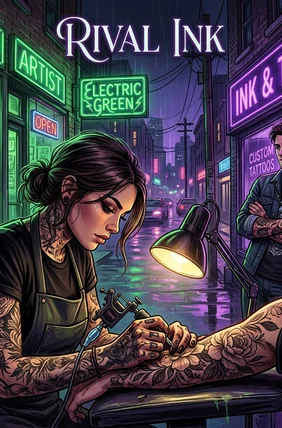
Lilac and Ashton co-inherited their grandmother's flower shop, which neither of them planned and both of them resent. He has money and opinions about modernization. She built every
Rival Ink earns the trope by giving both protagonists genuine claim on the shop they co-inherit. The hero wants modernisation. The heroine built every skill she has from the ground up. The conflict does not dissolve. They learn to negotiate around it, which is exactly the move rule four describes.
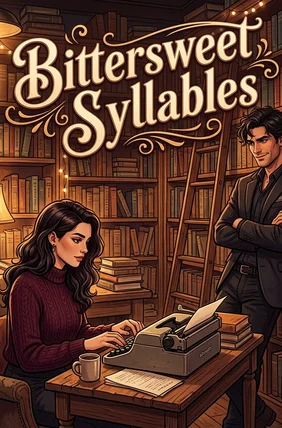
Amelia poured everything into The Book Nook, the independent bookstore her grandfather built from nothing. Now it's failing, and the man holding her loan is Julian Hawthorne, whose
Bittersweet Syllables is the harder version of the same trope. The heroine's bookstore is failing. The hero's company exists to buy and demolish bookstores like hers. There is no version of resolution where his company stops doing what it exists to do. The romance has to construct a private peace inside an unresolvable structural conflict. When it works, and the book makes it work, it is the trope's most demanding form.
In paranormal and fantasy romance, the trope is harder to execute, because the genre's structural appetite for external threat keeps pulling the protagonists onto the same team. The series that get it right — Sarah J. Maas's A Court of Mist and Fury (Rhysand and Feyre's slow inversion is a textbook case), Holly Black's The Cruel Prince — make the external plot incidental to the relationship, not the cause of it.
In dark romance and mafia, where enemies-to-lovers is enormously popular, the trope frequently fails for the reasons listed in the previous section. The hostility is usually one-sided (he is dangerous, she is the captive). The resolution is usually traumatic backstory revelation. The middle act is usually skipped entirely because hate sex arrives in chapter four.
This is not a failure of writers. It is a different genre using enemies-to-lovers iconography without writing the actual trope.
Where to start if you want the trope done right
Read Austen first. Pride and Prejudice is over two hundred years old and still does the trope more cleanly than anything since.
For modern romcom, The Hating Game by Sally Thorne is the most commonly recommended entry point and earns the recommendation. The middle act in particular survives the trope-traps.
For longer reads, Emily Henry's contemporary romances are reliable. Beach Read and People We Meet on Vacation both run the structure correctly.
For fantasy-romance, A Court of Mist and Fury (the second book of A Court of Thorns and Roses) is the best modern example. It is technically the middle book of a longer arc, but the enemies-to-lovers inversion happens entirely within its pages.
For YA, Holly Black's The Cruel Prince is the cleanest execution. Cardan and Jude actively undermine each other through most of the trilogy, and the reconciliation never quite resolves the original incompatibility.
You will, after a few of these, develop a reader's sense for where the trope is about to be cheated. The middle act is where it shows.
Where to find these
The eight titles named above can be tracked down via any reasonable bookshop, library, or Kindle Unlimited subscription. For quick lookups: