Romantasy Got Boring. Blame the Algorithm.
Everyone blames the algorithm. The algorithm is the amplifier, not the cause. Romantasy got boring because its signature mechanic, the fated bond, declares the
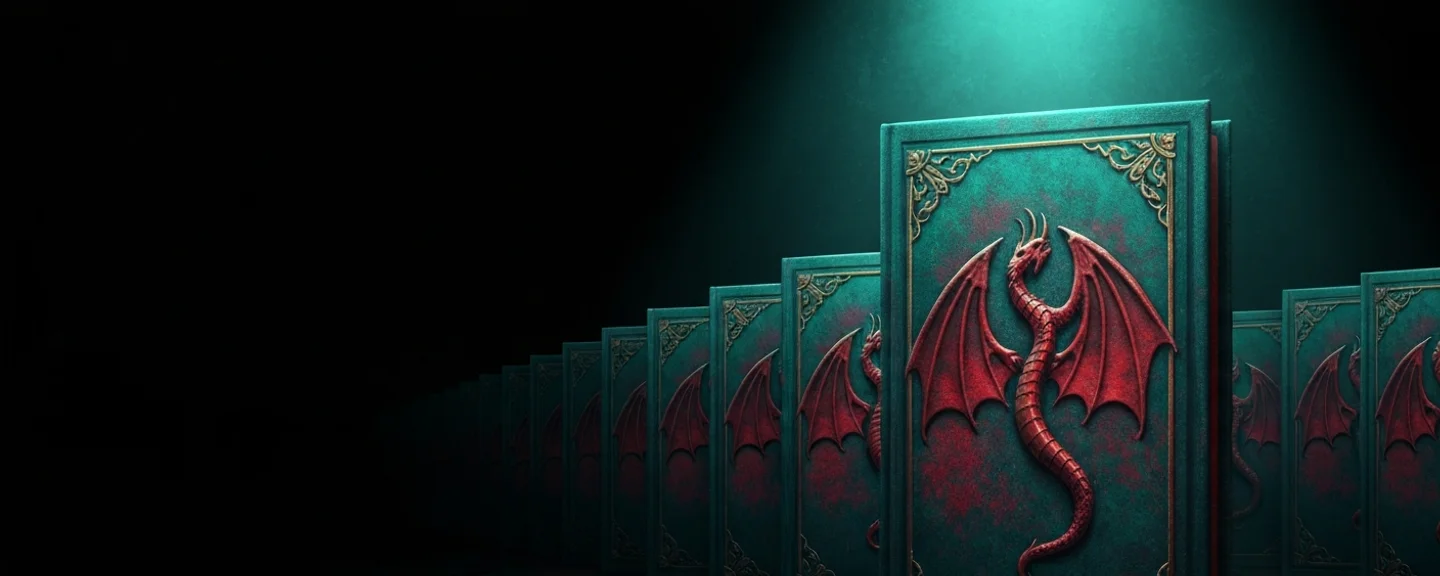
Walk to the romantasy table at the front of any chain bookstore. Before a single title resolves into words, the table reads as one object: a field of sprayed edges in teal and oxblood, embossed foil wings, a dragon or a crown or a sword through a flower. The category booked roughly six hundred and ten million dollars in 2024. From four feet away it looks like one book printed several hundred times.
The usual suspect is the algorithm. It is also the wrong one, or at least the incomplete one. A recommendation feed can only sell what the page first surrendered, and the sameness readers describe is not in the marketing. It is in the sentences. It begins with a single decision the genre made about love, and the decision is anti-romance.
The bond that arrives pre-declared
Romance runs on one engine: the earning of inevitability. A reader stays because resistance is slowly converting to certainty, and the pleasure is in watching the conversion happen against the characters' own wishes. Remove the conversion and you remove the genre.
Romantasy's signature mechanic removes it on purpose. The fated mate, the destined bond, the prophecy that names the couple before they have spoken: each declares the ending in the first act. The bond snaps into place, a voice says mine, and the question the whole form exists to ask, will these two arrive at each other, is answered before it is posed. What follows is not courtship. It is administration of a verdict already entered.
None of this is a complaint about happy endings. Romance has always promised the ending. What it withheld was the certainty of the route. The fated bond collapses the route into the promise, hands the reader the destination as an opening gift, and then asks four hundred pages to feel like a journey to a place everyone has already arrived.
Attraction on sight, love by chapter three
Watch the formula at sentence level and the tell repeats. The couple meets while bickering. One registers that the other is the most beautiful person they have ever seen, and the line is doing the work a hundred pages of behavior used to do. By the third or fourth scene a character privately concedes the feeling, and the concession is stated rather than earned.
This is telling wearing the clothes of tension. The prose announces emotion on a schedule because the structure underneath has already settled it. A scene cannot generate heat from a question it has answered, so the sentences supply the temperature by description instead of by event. The reader feels the difference even when they cannot name it, and what they name, eventually, is boredom.
The vocabulary narrows to match. Desire arrives in a small recurring lexicon: the smirk, the smolder, the growl, the jaw that ticks, the eyes that darken to a shade the narration always pauses to notice. These are stage directions for an actor the reader cannot see, and they recur because they are load-bearing. Once the structure has settled whether the characters want each other, the prose has only to keep insisting that they do, and insistence runs on a short list of words. The genre did not run out of language. It ran out of questions, and the language contracted around the gap.
A scene cannot generate heat from a question it has already answered.
The plot becomes the alibi
If the romance is settled by the end of the first act, something else has to carry four hundred pages, and that job falls to the fantasy. The war, the court, the trial, the contested throne: these arrive to manufacture the suspense the love is no longer allowed to. The worldbuilding swells precisely in proportion to how early the bond was sealed.
This is why so much current romantasy reads as a competent fantasy novel with a foregone couple stapled to its spine. The dragon is not the problem. The dragon is the alibi, the thing that keeps the pages turning now that the relationship has nothing left to discover. Fourth Wing (Rebecca Yarros, on Entangled's Red Tower imprint) sold twelve million copies in under two years on the strength of that machinery; A Court of Thorns and Roses (Sarah J. Maas, Bloomsbury) built the template the machinery copies. Both are propulsive. Neither is, structurally, a romance in suspense about its own outcome.
What the algorithm actually did
Here the feed earns its share of the blame, though not as the author of the problem. It is the amplifier. Romantasy sales ran from about four hundred and fifty-four million dollars in 2023 to a projected six hundred and ten million the year after, and the trade tracker Circana flagged a saturation point by 2025. Money at that scale buys against comps, and a comp rewards the most recognizable move on the board. The most recognizable move in romantasy is the pre-declared bond.
So the industry selected, again and again, for the one mechanic that voids the genre's engine, because that mechanic is the easiest to recognize and the cheapest to reproduce. Reactor counted the toolkit at tropes, smut, and sprayed edges; one critic of the genre described books conceived from the jump as products for TikTok. Both are describing the same thing from outside. The feed did not invent the foregone bond. It industrialized it, the way Instagram industrialized the cover before the prose was ever consulted.

What the genre gave up
Romance once paid for its endings. The marriage plot withheld the marriage for three volumes. The gothic let the reader doubt whether the man was a refuge or a threat until very late, and sometimes answered wrong. Romantasy has older and stranger roots than its 2022 branding admits, roots in which the bond was a destination rather than a starting condition, and the heroine could be difficult because no comp existed yet to forbid it.
What an earned bond reads like is not a mystery. It reads like resistance the text takes seriously: two people whose reasons for staying apart are real enough that the reader is not certain they will be overcome. The certainty has to be in genuine doubt for the resolution to land. Strip the doubt and the most lavish reunion reads as a formality, beautifully lit and emotionally inert, because the reader was never once permitted to fear it might not come.
The fated bond traded all of that for certainty, and certainty is comfortable, and comfort sells. But the same readers buying it report fatigue, the heat-ranked checklist of tropes curdling into obligation. A reader can love a formula and still feel it close over their head. The charts that look like demand may be measuring habit, and habit is the slowest market signal to break.
The fated bond traded suspense for certainty. Certainty is comfortable. It is also the end of the genre's engine.
The proof that it is a choice
The formula is not destiny, and the clearest evidence is a romantasy that refused it and sold anyway. In The Bridge Kingdom (Danielle L. Jensen), the heroine arrives as a bride under a treaty of peace and as a spy under orders to find the weakness that will let her own people destroy the kingdom, and its king. The bond is not declared. It is sabotaged from the first page, by the protagonist herself, and every step she takes toward the king is also a step toward betraying him. The reader cannot coast on the outcome, because the heroine is working to make the outcome a catastrophe.
Jensen is not a literary outlier smuggling craft past the market. The Bridge Kingdom is a New York Times bestseller, as is her later A Fate Inked in Blood. At the prestige end, Naomi Novik's Spinning Silver keeps its romance behind genuine adversarial stakes and won acclaim for it. Different altitudes, one refusal: the bond is made to cost something. What these books establish is that the boredom is not a constraint the genre operates under. It is a decision the genre keeps making, and that a recommendation engine keeps paying for.
After saturation
A formula optimized against a feed has no reverse gear, and this one optimized away the very uncertainty romance is built to deliver. The same platform logic that reshapes what authors write and how they release it settles the book before a sentence exists. What rescues a category at saturation is never another execution of the comp. It is the book the model would never have commissioned: the romantasy that makes the bond a question again, that lets two people fail to be inevitable, that asks the fantasy to share the suspense instead of supplying all of it.
Six hundred and ten million dollars. One romantasy table that reads, from four feet away, as a single book printed several hundred times. The genre did not get boring because there were too many dragons. It got boring the moment it decided the love was settled on page one, and then built a recommendation engine to make sure every book decided it the same way.