The Book Boyfriend Is Two Hundred Years Old
The brooding, dangerous, secret-haunted love interest that BookTok calls morally grey is not new. He has a birthday, 1812, and a maker, Lord Byron. A genealogy
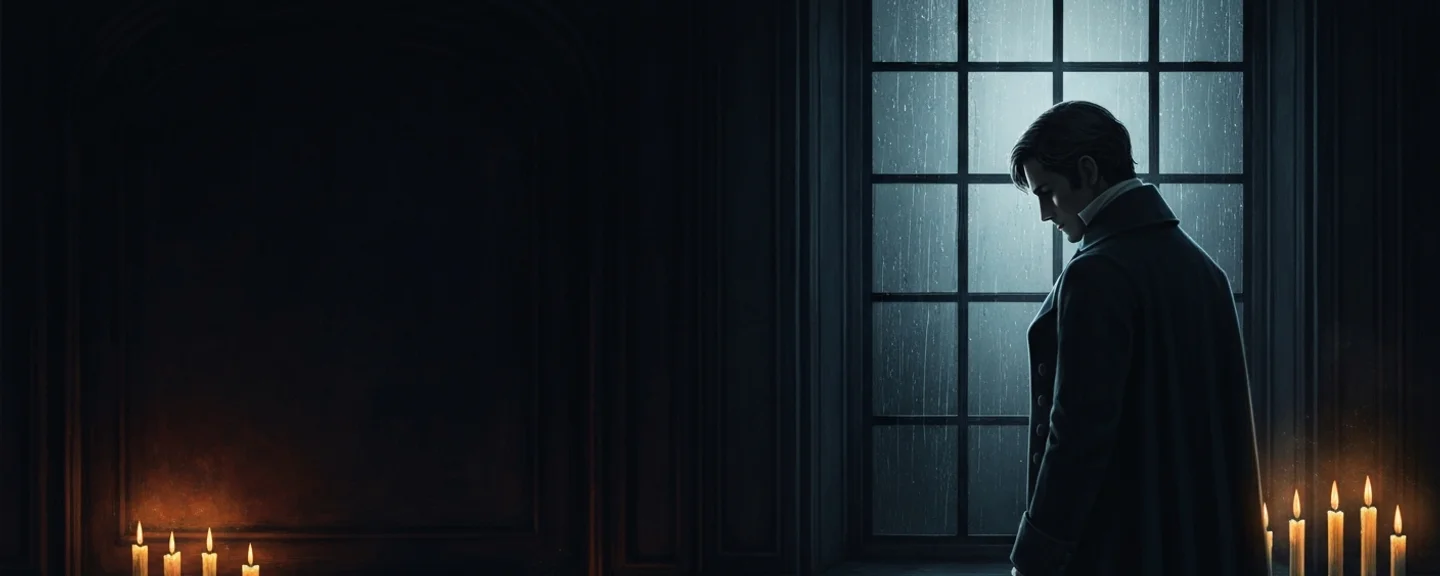
The morally grey love interest is having a moment. The brooding, dangerous, secret-haunted man that dark romance has spent the past decade making respectable, the one BookTok discusses as though women had only just been granted permission to want him, arrives on the shelf as a discovery.
He is not a discovery. He is two hundred years old.
He has a birthday, 1812, and a maker, an English poet who was himself the first person to play the part. What follows is a genealogy: six points on a line that runs from a Romantic verse epic to a mafia don, each one the same man in a different coat.
The makerByron, 1812
The type begins with a real person performing it. Lord Byron published the first two cantos of Childe Harold's Pilgrimage in 1812 and woke, in his own account, to find himself famous.
The hero of the poem was proud, travel-worn, haunted by a guilt never quite named, and understood at once to be the poet himself. Lady Caroline Lamb supplied the epitaph the archetype has never shaken: mad, bad, and dangerous to know.
Byron refined the figure across the Oriental tales, The Giaour (1813), The Corsair (1814), Lara (1814), and the closet drama Manfred (1817). Thomas Macaulay later fixed the definition in a sentence: a man proud, moody, cynical, with defiance on his brow and misery in his heart, a scorner of his kind, implacable in revenge, yet capable of deep and strong affection.
Every trait the modern dark hero is praised for owning was itemised before 1820.
He did not invent the figure from nothing, which is the first warning that this line runs deeper than any one author. Childe Harold was assembled from older brooders: Milton's Satan from Paradise Lost (1667), proud and ruined and magnificent in defeat; the paralysed introspection of Hamlet; the doomed sensibility of Goethe's young Werther (1774); the guilt-driven Faulkland of William Godwin's Caleb Williams (1794).
Byron''s genius was not the character. It was the decision to wear him in public until the man and the mask could not be told apart.
He was also, not incidentally, the first author marketed as a personality. Portraits sold, women wrote to him by the sack, and readers bought the poems partly to be near the man who had written them.
The Byronic hero arrived bundled with the first modern literary celebrity. He was a product from the start, sold on the implied promise that the dangerous figure on the page corresponded to a real one a reader might, disastrously, meet. Romance has been making and breaking that promise ever since.
The room where the monster was madePolidori, 1819
In the wet summer of 1816, at the Villa Diodati on Lake Geneva, Byron set his houseguests a ghost-story contest. One guest, Mary Shelley, produced Frankenstein.
Another, Byron''s personal physician John Polidori, took a fragment of Byron''s and wrote The Vampyre, published in 1819. Its villain, the seductive and predatory aristocrat Lord Ruthven, was a transparent and rather vengeful portrait of Byron. He became the template for the modern vampire.
This is the genealogy''s most useful secret. The brooding romantic hero and the vampire lover are not cousins. They are the same ancestor, born in the same room, in the same week, out of the same man.
Ruthven walks directly into the century that follows: the penny-dreadful Varney the Vampire (1845), Le Fanu''s Carmilla (1872), and at last Bram Stoker''s Dracula (1897), the aristocrat whose menace is inseparable from his seduction. Everything later readers would meet as the pre-Twilight vampire was already Byron with fangs, and the fangs were always a little beside the point.
The brooding hero and the vampire lover are not cousins. They are the same ancestor, born in the same room.
The year it doubledthe Brontës, 1847
The figure left poetry for the novel, and in a single year it split into the two roads it still travels.
In 1847 Charlotte Brontë gave Jane Eyre a master, Edward Rochester: a Byronic hero with a secret wife in the attic, a man who lies, manipulates, and very nearly commits bigamy. He is permitted redemption only after fire, mutilation, and the loss of his sight have levelled the power between them.
The same year her sister Emily gave Wuthering Heights a Heathcliff: a Byronic hero offered the same chance who refuses it, who answers his own wounding by spending two generations destroying everyone within reach.
Redeemable and unredeemable. This is the fork the archetype has never closed.
Every dark-romance hero since stands on one of these two roads, and an experienced reader usually knows which within a chapter: the man whose cruelty is a wound to be healed, or the man whose cruelty is the point. The Brontës did not invent the brooding man. They sorted him, and dark romance still files by their system.
The map still reads cleanly two centuries on. The wounded billionaire who thaws, the alpha gentled by his fated mate, the rake reformed by the right woman: these are Rochester, redemption bought with suffering.
The captor who is never quite sorry, the villain handed his own love story, the hero the cover copy calls grey when the page is closer to black: these are Heathcliff, whose appeal was never that he might one day improve. Knowing which book you have bought is largely a matter of knowing which Brontë you are reading.

The husband with a locked roomdu Maurier, 1938
The archetype carried easily into the twentieth century by way of the gothic, where its secret-haunted quality found a natural home.
Daphne du Maurier''s Rebecca (1938) gives us Maxim de Winter: wealthy, withholding, shadowed by a dead first wife, a man the narrator cannot read and the reader is not meant to trust. Is he a refuge or a threat.
The novel withholds the answer for hundreds of pages, and when it finally arrives it is worse than the heroine feared and somehow does not cool her devotion. That is precisely the unsettling machinery the genre would later make its house style.
The suspense of not knowing whether the beloved is safe is the same engine Rochester ran on ninety years earlier, and it powers the entire modern shelf of marriages-of-convenience and captive brides. The coat is twentieth-century. The man is 1812.
The coat changes againCullen, Grey, the don
Edward Cullen, in 2005, is Lord Ruthven with a conscience and a vegetarian diet: the predatory aristocrat rebuilt as a boyfriend who watches you sleep for your own protection.
Christian Grey, who began life explicitly as Twilight fan fiction before E. L. James filed off the serial numbers in 2011, is Rochester with a non-disclosure agreement and a contract.
The possessive billionaire, the mafia patriarch, the alpha with the body count and the tragic childhood, are the same figure in this decade''s tailoring. The traits are unmoved from Macaulay''s sentence: proud, moody, secret guilt, implacable in revenge, capable of deep affection toward exactly one person in the world.
What has genuinely changed is the authorship. The Byronic hero was first written by men, frequently as self-portrait, and handed to women to admire.
He is now written, overwhelmingly, by women, for women, with the danger arranged so that it discharges on the reader''s terms rather than at her expense. The power has quietly changed hands inside the fantasy. That is a real shift, and it is close to the only part of this whole story that is actually new.
What keeps getting rediscovered
A genre with a short memory will keep mistaking inheritance for invention. The morally grey hero is not a development of the 2010s, not a permission BookTok granted, not a frontier that dark romance opened.
He is among the oldest words in the language romance speaks: coined by a poet who became his own first draft, assembled out of Milton and Goethe before that, and refined across a single decade two centuries ago.
Each generation meets him and believes it is the first. That belief is the only thing about him that is ever young.
The hero is not a chapter in the romance novel. He is one of its founding sentences, and he has been waiting on the shelf, in one coat or another, the entire time.
---
The genealogy, in books: